
A Territory Holdings commitment
Habitat is nota footnote.
One percent of every Territory Holdings platform's profits goes to land, water, and habitat. It is an obligation written into how the company works, not a campaign we run when the quarter allows it.
The commitment
One percent, built in.
Stated plainly once, then held to. There is no campaign attached to it and nothing to opt into.
One percent of every Territory Holdings platform’s profits is directed to land, water, and habitat conservation. HunterPass carries that obligation from day one, the same as AnglerPass does.
Profits, not revenue. The revenue version sounds better and is a promise a young platform cannot keep through the years it loses money. We would rather make the smaller commitment and actually meet it.
Which also means being straight about the present: until there are profits, there is a commitment and an accounting structure, not a check. That is why habitat stewardship sits on our roadmap rather than in our launch claims — a commitment is not a feature, and dressing one up as the other is exactly what this brand should not do.
The record
How hunting already funds American conservation.
Worth stating once, without ceremony, because it is the part of this story most often left out of the conversation entirely.
| Mechanism | Scale | Where it goes |
|---|---|---|
| Pittman-Robertson excise tax | $16B+ since 1937; recently over $1B a year | State wildlife restoration and hunter education, funded by an 11% federal excise on firearms, ammunition, and archery equipment |
| Hunting license revenue | ~15.2 million licenses in 2024 | State wildlife agency budgets — the American System of Conservation Funding |
| Hunter spending | ~$45.2 billion in 2022 | Rural economies, land management, and the businesses that keep working land working |
| Private habitat investment | Plots, burns, TSI, water | Paid for by landowners and clubs, on the 72% of the Lower 48 that is privately owned |
Figures from published federal and industry sources. We cite them because they are true, not because they settle an argument.
Habitat & herd health
The work that actually moves a property.
None of this is new to the people we are building for. What is new is being able to prove it happened, on which acres, and what changed afterwards.
Doe harvest and age structure
The unglamorous heart of deer management. A club that meets its doe target and lets young bucks walk changes its herd in three seasons; one that does not, does not.
Prescribed fire
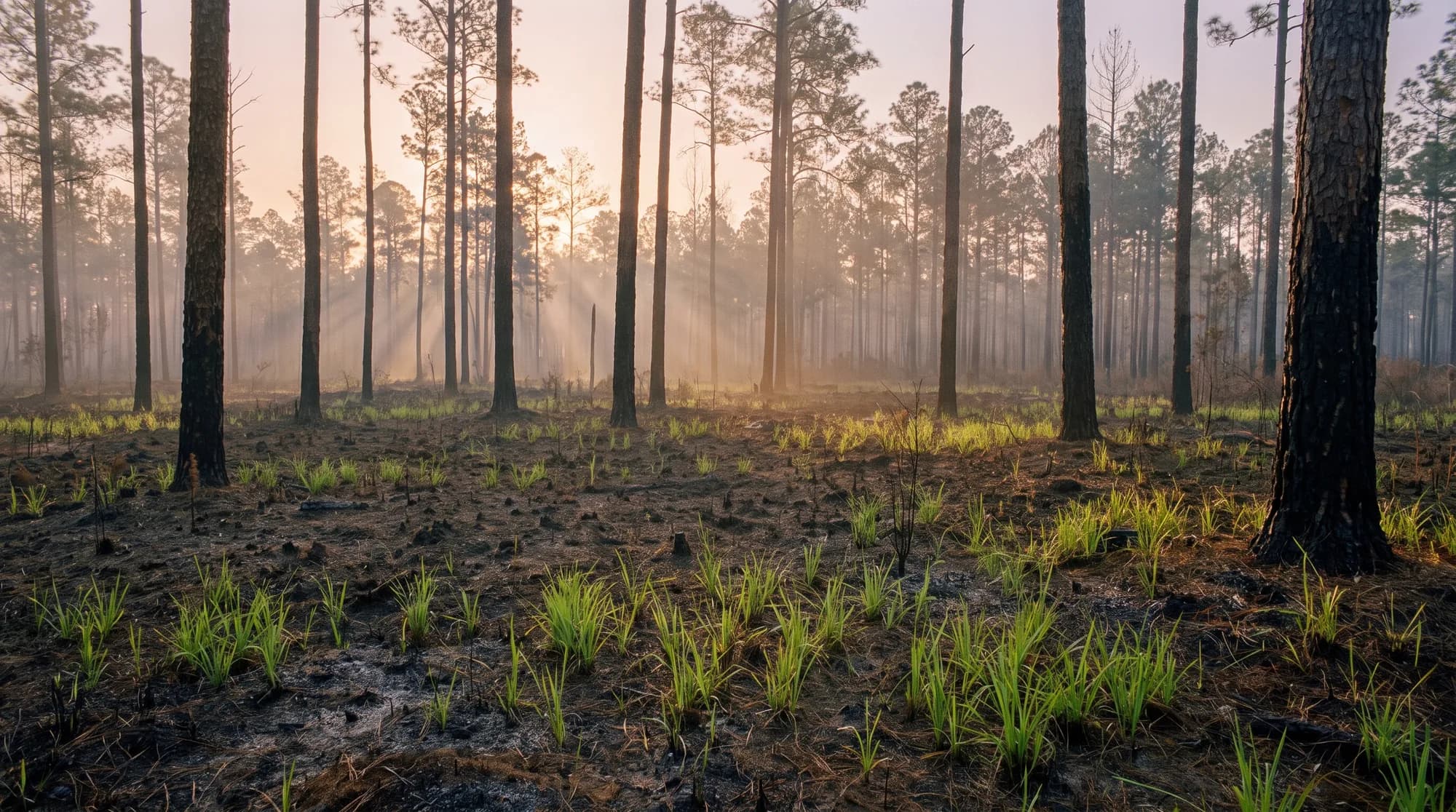
The most effective habitat tool in the Southeast and the least used. Burning on rotation resets browse, opens the understory, and brings back the native grasses quail need.
Timber stand improvement
Thinning and selective harvest let light onto the floor. A closed pine canopy is a green desert regardless of how many acres of it you hold.
Food plots, honestly
Useful, oversold, and not a substitute for cover. A plot on ground with no bedding habitat concentrates deer for a hunter without improving anything for the deer.
Water and wetland management
Pumps, levees, and moist-soil units are what make waterfowl ground worth anything — and they are an annual operating cost, not a one-off improvement.
Native cover restoration
Native warm-season grasses and edge feathering do more for quail, turkey poults, and fawn survival than any amount of supplemental feed.
Pressure & fair chase
The cheapest conservation there is.
Rest costs nothing but discipline, and it is the single biggest lever most clubs never pull.
Ground hunted every weekend of a seventeen-week Alabama season stops producing long before it closes. The deer have not left — they have stopped moving in daylight, which for a hunter is the same thing and for the property is worse, because next season starts from there.
Per-stand caps, rest rotations, and wind-aware assignment are the mechanics. What makes them possible is a record of who actually sat where, which is precisely what a paper sign-in sheet has never given anybody.
Fair chase
The ethic that gives an animal a reasonable opportunity to escape — the line between hunting and merely killing. It is older than any of the technology involved and it does not need our help.
Where a platform can help is smaller and more practical: making sure the person in the stand knows this unit’s legal-buck criteria, that baiting is banned statewide in Colorado, that the carcass-transport rule changed this year, and where the boundary actually runs. Most violations are ignorance, not malice.
Harvest data & science
What a booking system can hand a biologist.
This is the genuinely novel contribution, and it is a by-product rather than an initiative.
A voluntary harvest log records the hunts that produced something and silently discards the rest, which means you can count animals but never effort. Because every hunt here begins as a booking, hunter-hours are captured whether or not anything was taken.
That single fact converts a pile of records into rates: harvest per hunter-hour, sightings per sit, pressure by stand across a season. Those are the numbers a wildlife biologist can actually manage against, and almost nobody has them at property scale.
The records belong to the club or landowner whose ground produced them. We do not pool them into a product and we do not sell them.
Same season, two records
41 deer
A count. Up from 34 — but nobody can say why.
41 deer · 1,180 hunter-hours
A rate. Comparable across seasons, across stands, and against the doe target set in July.
EarthNow partnership
The numbers under everything else.
Habitat work happens on one property. The conditions it happens in do not.
HunterPass has partnered with EarthNow, a real-time planetary health monitoring platform, the same as AnglerPass does. It tracks the metrics that quietly set the terms for every property on this network — atmospheric CO₂, tree cover, water, and soil.
Those are not abstractions to anyone who manages ground. Drought decides whether a food plot is worth planting. Water sets what a marsh is worth to lease. Timber cover and soil are the whole argument for a burn rotation. A landowner reading their own harvest records is looking at one property; this is the weather the whole thing sits in.
We surface it here rather than write about it, because the data is more useful than our opinion of it.
Earth’s vital signs — live
Conservation partners
Who we work alongside.
Elk, deer, turkey, and waterfowl organizations have been doing this work for decades. Our role is to be useful to them, not to compete for the credit.
Species and habitat organizations
Deer, elk, turkey, and waterfowl groups whose habitat programs are the reason a great deal of private ground is worth hunting at all. Co-marketing where it is honest, funding as profits allow.
Consulting foresters and biologists
The firms advising thousands of Southeastern landowners on what their ground is worth and how to improve it. We would rather make their advice provable than market around them.
Land trusts and working-lands programs
Recreational income is one of the things that keeps working land working rather than subdivided. Making that income provable is a conservation act in itself.
Fair questions
Including the skeptical ones
Is the 1% of profits or of revenue?
Profits, and we would rather say the smaller true thing than the larger flattering one. One percent of revenue sounds more generous and would be a commitment we could not keep through the years a young platform loses money. One percent of profits is a standing obligation across every Territory Holdings platform, and it survives contact with reality.
What happens to the 1% before there are profits?
Nothing, honestly — and pretending otherwise would be exactly the kind of claim this brand should not make. What exists today is the commitment and the accounting structure behind it. What does not exist today is a habitat software product, which is why habitat stewardship is on our roadmap rather than in our launch list.
Isn't hunting bad for wildlife?
Regulated hunting is the primary funding engine of American wildlife conservation, and that is a matter of record rather than opinion. The Pittman-Robertson excise tax on firearms, ammunition, and archery equipment has directed more than $16 billion to state wildlife restoration since 1937, recently exceeding $1 billion a year, and license revenue underwrites state wildlife agency budgets on top of it. Unmanaged deer populations, by contrast, damage the habitat that every other species in the system depends on.
What does pressure management actually change?
More than habitat work does, in the short term. Ground hunted every weekend for a seventeen-week Alabama season stops producing well before it closes — the deer are still there, they have simply stopped moving in daylight. Rest rotations and per-stand caps are the cheapest conservation available to a club, because they cost nothing but discipline.
Are you going to lecture me about this?
No. The people we are building for have generally been doing habitat work and doe management for longer than we have existed, and the last thing they need is a software company explaining conservation to them. We state the commitment once, we build the records that make good management provable, and then we get out of the way.
Built in, not bolted on
Good management should be provable.
The records that prove your ground is well managed are the same records that justify what you charge for it. Manage it properly and you should be able to show it.